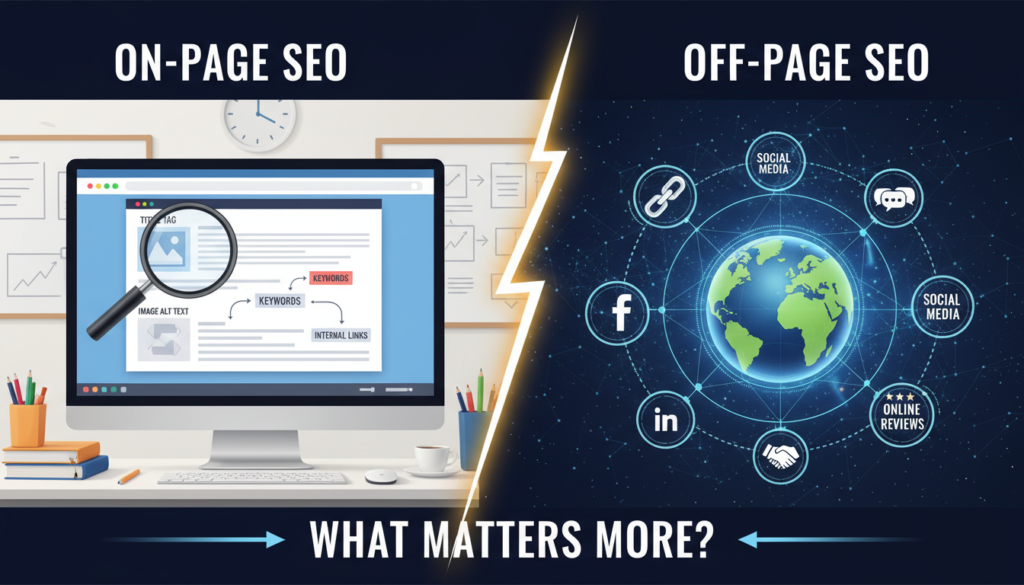
If you are trying to grow your website traffic through search engines, you have probably heard this question many times: On-Page vs Off-Page SEO – what matters more?
Some marketers say content is king. Others say backlinks are everything. As a digital marketer, you quickly realize that both perspectives have merit. The truth? Both are essential — but they play different roles in your SEO strategy.
In this detailed guide, we’ll break down:
- What is On-Page SEO
- What is Off-Page SEO
- The key differences
- Which one matters more
- How to balance both for maximum rankings
Let’s dive in.
What is On-Page SEO?
On-Page SEO refers to all the optimizations you do inside your website to improve search engine rankings.
It focuses on making your content clear, valuable, and technically optimized so search engines understand it better.
Key Elements of On-Page SEO
1. Keyword Optimization
Using your focus keyword — in this case, On-Page vs Off-Page SEO — naturally in:
- Title
- Headings (H1, H2, H3)
- First 100 words
- Meta description
- URL
- Image alt text
But remember: avoid keyword stuffing. Rank Math will flag it if overused.
2. High-Quality Content
Google ranks content that:
- Solves real problems
- Is well-structured
- Provides depth
- Matches search intent
Long-form content (1000+ words) often performs better because it covers topics comprehensively.
3. Proper Heading Structure
Use:
- H1 for main title (only once)
- H2 for main sections
- H3 for sub-sections
This helps both users and search engines scan your content easily.
4. Internal Linking
Internal links connect one page of your website to another. They:
- Improve site structure
- Help distribute link equity
- Increase time on site
- Help Google crawl faster
Example:
If you have written about Keyword Research Guide, link to it naturally inside this article.
5. URL Structure
Keep it clean and simple:
example.com/on-page-vs-off-page-seo
Avoid long URLs with unnecessary words.
6. Image Optimization
- Compress images
- Add keyword-rich alt text
- Use descriptive file names
Example alt text:
“On-Page vs Off-Page SEO comparison chart”
7. Technical SEO Basics
Though technical SEO is a separate category, some parts overlap:
- Fast loading speed
- Mobile-friendly design
- SSL certificate (HTTPS)
- Schema markup
Rank Math can help with schema implementation easily.
What is Off-Page SEO?
Off-Page SEO refers to all the actions taken outside your website to improve rankings.
It mainly focuses on building authority and trust.
If On-Page SEO tells Google what your page is about, Off-Page SEO tells Google how trustworthy your website is.
Key Elements of Off-Page SEO
1. Backlinks (Most Important Factor)
Backlinks are links from other websites pointing to your site.
Google sees backlinks as votes of confidence.
But not all backlinks are equal.
High-quality backlinks come from:
- Authoritative websites
- Relevant industry blogs
- Trusted domains
- Websites with high domain authority
One strong backlink is better than 100 spammy ones.
2. Guest Blogging
Writing articles for other websites in your niche helps:
- Build authority
- Earn quality backlinks
- Increase referral traffic
3. Social Signals
While social media links may not directly affect rankings, they:
- Increase visibility
- Drive traffic
- Improve brand awareness
More visibility often leads to natural backlinks.
4. Brand Mentions
Even unlinked brand mentions can build credibility and authority.
Google recognizes brand signals over time.
5. Influencer Outreach
Collaborating with influencers and industry experts increases trust and backlink opportunities.
On-Page vs Off-Page SEO: Key Differences
| On-Page SEO | Off-Page SEO |
|---|---|
| Done inside website | Done outside website |
| Focuses on content & structure | Focuses on authority & trust |
| Fully in your control | Partially outside your control |
| Includes keywords & technical SEO | Includes backlinks & brand building |
| Immediate improvements possible | Takes time to build |
What Matters More: On-Page or Off-Page SEO?
Here’s the honest answer:
On-Page SEO comes first. Off-Page SEO makes it stronger.
Let’s explain.
If your website:
- Has poor content
- Is not optimized
- Loads slowly
- Has no clear structure
Then even strong backlinks won’t help much.
But if your website is perfectly optimized and has no backlinks, it will still struggle to rank for competitive keywords.
Think of it like this:
- On-Page SEO = Foundation of a house
- Off-Page SEO = Reputation of the house in the neighborhood
You need both.
The Ideal SEO Strategy (Balanced Approach)
Instead of choosing between On-Page vs Off-Page SEO, focus on combining them strategically.
Step 1: Perfect Your On-Page SEO
- Perform keyword research
- Optimize titles and headings
- Improve readability
- Add internal links
- Use schema markup
- Optimize images
Use Rank Math to ensure:
- Focus keyword density is natural
- Meta description includes keyword
- SEO title includes keyword
- URL is optimized
- Content length is sufficient
Aim for a Rank Math score above 80.
Step 2: Start Building Authority (Off-Page SEO)
After publishing optimized content:
- Reach out for guest posts
- Share on LinkedIn and social media
- Submit to relevant directories
- Build niche-relevant backlinks
- Create shareable infographics
Remember: consistency matters more than speed.
Common Mistakes to Avoid
1. Ignoring On-Page SEO
Many beginners jump straight into link building without optimizing content.
2. Buying Low-Quality Backlinks
Cheap backlinks can harm your website.
3. Keyword Stuffing
Overusing the focus keyword can lead to penalties.
4. Ignoring User Experience
SEO is not just about search engines — it’s about people.
How Google Really Decides Rankings
Google considers over 200 ranking factors. But the core pillars are:
- Relevance (On-Page SEO)
- Authority (Off-Page SEO)
- User Experience
- Technical Performance
This clearly shows why the debate of On-Page vs Off-Page SEO should not be about choosing one — but balancing both.
Final Verdict: On-Page vs Off-Page SEO
If you are just starting:
Focus 70% on On-Page SEO
Focus 30% on Off-Page SEO
Once your site is optimized and structured well:
Shift to 50% On-Page and 50% Off-Page
Because at higher competition levels, authority becomes the deciding factor.
Conclusion
The debate around On-Page vs Off-Page SEO often creates confusion. But the truth is simple:
On-Page SEO helps search engines understand your content.
Off-Page SEO helps search engines trust your content.
One without the other is incomplete.
If you want long-term SEO success, build a strong foundation with optimized content and then grow your authority with smart backlink strategies.
SEO is not a one-time task — it is a continuous process.