If you’ve ever wondered why some users visit your website, engage with your content, or add an item to their cart only to leave, you’re not alone.
This is why understanding the customer journey in digital marketing is so important.
Digital marketing is more than just advertising, sharing posts on Instagram, or getting good rankings on Google. It involves understanding how a person moves from “I don’t know this brand” to “I trust this brand” and finally to “I’m ready to buy.”
This entire process is called the customer journey. When you fully understand the customer journey in digital marketing, your strategies become smarter, more effective, and focused on people.
Let’s simplify this for better understanding.
What Is the Journey in Digital Marketing?
The journey in digital marketing describes the path a customer follows before deciding to make an online purchase.
However, it’s not a straight line.
People don’t typically see your ad and immediately buy from you. Instead, they:
- Discover you somewhere
- Check your profile
- Visit your website
- Compare you with others
- Read reviews
- Forget about you
- See your ad again
- Finally decide
This process is filled with emotions, questions, doubts, and curiosity.
When we understand this journey, we stop expecting quick results and start building meaningful connections.
Understanding the Customer Journey: Why It Really Matters
Often, the mistake that businesses—large or small—often make is that they are too concerned about the present moment. They are trying to sell at all costs. People are not looking to buy because they have to. People are looking to buy based on whether or not they feel understood.
If your marketing says “Buy now,” you are skipping those early crucial stages of the digital journey.
Know the Journey, and You Gain:
- Timely and relevant content which hits the right notes
- Less waste in ad spend
- Higher Conversion Rates
- Lasting relationships, not one-off transactions To put it simply, the knowledge of the process makes marketing feel like guidance instead of pressure.
Understanding the Customer Journey: Why It Really Matters
Often, the mistake that businesses—large or small—often make is that they are too concerned about the present moment. They are trying to sell at all costs. People are not looking to buy because they have to. People are looking to buy based on whether or not they feel understood.
If your marketing says “Buy now,” you are skipping those early crucial stages of the digital journey.
Know the Journey, and You Gain:
- Timely and relevant content which hits the right notes
- Less waste in ad spend
- Higher Conversion Rates
- Lasting relationships, not one-off transactions To put it simply, the knowledge of the process makes marketing feel like guidance instead of pressure.
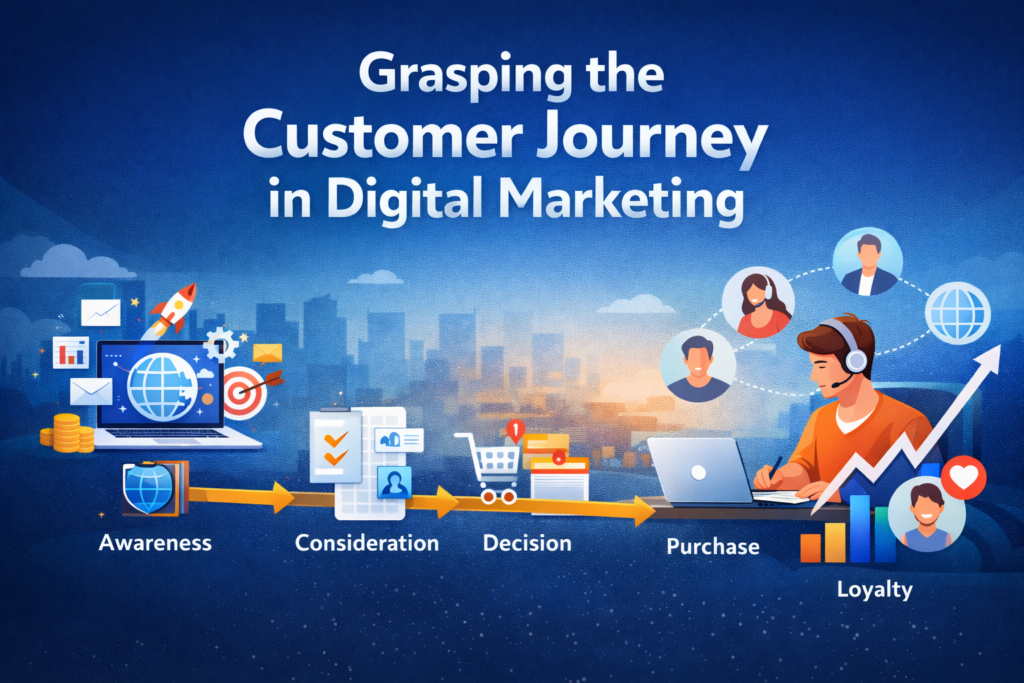
The 5 Main Stages of the Customer Journey
Let’s explore the journey in digital marketing step by step, using real-life examples.
1. Awareness Stage – “I Just Realized I Have a Problem”
This is the beginning.
The customer is not looking for your brand. They are looking for a solution.
For example:
- Someone searches “Why is my skin breaking out?”
- A business owner searches “How to get more website traffic?”
- A student searches “Best digital marketing course online”
At this stage, they are gathering information.
Your job here is not to sell.
Your job is to educate.
Content that works well in this stage:
- Blog posts
- Social media tips
- YouTube videos
- Informative ads
- SEO content
If you understand the journey in digital marketing, you know this is where visibility matters more than selling.
2.Consideration Stage – “What Are My Options?”
Now the individual is aware of the problem they have. They are examining the solutions for their problem.
They may:
- Compare various brands
- Read reviews
- Check pricing
- Visit various websites
In this case, they are evaluating.
It is at this point that trust comes into play.
The type of content that will work well in this stage is:
- Case studies
- Testimonials
- Comparison guides
- Service pages with details
- Email newsletters If you do not go through this step and try to make sales too soon, you could very well lose them. The process of digital marketing teaches us to be patient.
3.Decision Stage – “I’m Ready to Choose”
Now the customer is close to buying.
But they still need reassurance.
Small doubts can stop them:
- Is this worth the price?
- What if it doesn’t work?
- Is this company reliable?
At this stage, strong calls-to-action, limited offers, guarantees, and social proof work well.
Retargeting ads are very powerful here. Many people don’t buy the first time. But when they see your ad again, they remember you.
Understanding the journey in digital marketing helps you stay visible at the right moment.
4. Purchase Stage, “I Trust You”
The customer finally makes a purchase.
However, many companies forget one thing:
The process does not end with the purchase.
If you do not communicate with the customer after the sale, you are missing a huge opportunity.
5. Loyalty and Advocacy Stage, “I’ll Recommend You”
Satisfied customers become regular customers.
Even better, they become promoters.
They:
- Leave reviews
- Tag you on social media
- Recommend you to friends
- Share your content
This stage is frequently neglected in online marketing, but it is extremely effective.
It is less expensive to retain customers than to find new ones. Email marketing, follow-up communications, loyalty schemes, and effective customer service are important in this regard.
The Emotional Side of the Journey by Free Style
Digital Marketing is not of numbers and dashboards; feelings punctuate every move-what best explains psychology.
- Curiosity
- Skeptism
- Of fear
- Excitement
Trust - Satisfaction
Knowing this enables you to hit closer to home when creating content.
Instead of a hard sell like:
“Buy our digital marketing services.” Try: something a little warmer: “Can’t seem to get consistent leads? Let’s fix that.” See the difference? The first feels like a push; the second conveys that you know.
Mapping the Path for Your Business
While understanding the digital marketing journey is straightforward, carrying it out requires a different level of skill.
One simple method to achieve this:
Step 1: Know Your Audience
To start,
Ask yourself:
- Who are they?
- What problems do they have?
- Where do they spend time online?
Step 2: Identify Their Questions at Each Stage
Awareness: What are they looking for?
Consideration: What are they comparing?
Decision: What fears hold them back from buying?
Step 3: Create Content for Every Stage
Avoid sharing random content. Develop a collection of material for each stage of the journey.
If you are a freelance digital marketing expert:
Awareness: “Why Your Business Isn’t Getting Online Leads”
Consideration: “SEO vs Paid Ads: Which Is Right for You?”
Decision: “Case Study: How I Helped a Local Business Increase Sales by 40%”
That is, in essence, what it is like to guide someone along their digital marketing path.
Typical Business Pitfalls
Let’s get right to the point.
Many businesses rush into success before they’re ready.
These are the typical problems we observe:
Promoting to a group of people you don’t truly know
Producing content without a clear strategy
Not following up
Making sales the sole priority
- Ignoring the real actions of customers. Every action in digital marketing is unclear if the customer’s journey is not understood. But once you understand that, everything else becomes clear.
The Power of Data in the Customer Journey
Feelings are important, of course. But data allows us to grasp behaviors.
The tools that we dispose of:
- Google Analytics
- Facebook Pixel
- Google Ads reports
- CRM Software
What they reveal
- Where users leave off
- Which pages capture their attention
- Which Ad Actually Converts – Which emails get opened With this given, one can now fine-tune the digital marketing process. However, it is worth noting: data guides the process, but it does not substitute the human factor.
Final Thoughts
The change in marketing, the thing to focus on, is not the tactics and pitches, but how to move from being a marketer-seller to being a marketer-guide.
“Digital marketing isn’t about selling; it’s about guiding someone from confusion to clarity”
If you take the time to:
– truly understand their problems
- create information that’s really useful
- build real trust
- stay consistent
- Follow up after a purchase “You then set up a sequence that makes perfect sense naturally. The sale occurs more or less naturally on its own because it feels authentic. A well-crafted digital strategy remains relatable to people. Once you get the entire customer journey, you begin to see yourself differently. You begin to see yourself as more of a partner.”